

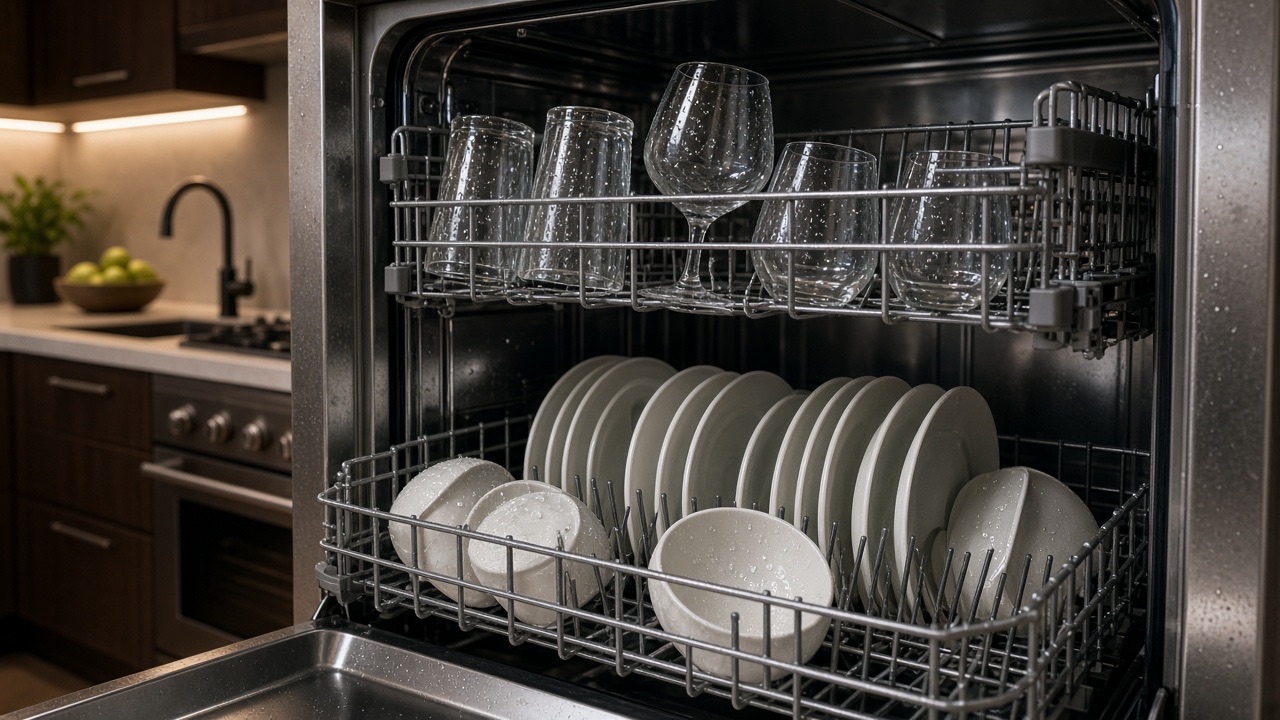
Specialized Dacor Appliance Repair in Los Angeles and Orange County
Dacor dishwasher not drying dishes? Use this model-aware guide to narrow the likely cause, try safe external checks, and know when the problem needs professional diagnosis.
Wet dishes from a Dacor dishwasher usually point first at rinse aid, the drying option and how the racks were loaded, and only then at a heating problem. If glasses are uniformly wet after a cycle with heated dry selected and the inside stays cool, book a visit.
A Dacor dishwasher not drying dishes is often options, rinse aid, and load pattern before it is a heater. Plastic on the top rack will still be wet on many cycles even when the heating circuit is healthy.
If glasses are wet and the tub is cool at the end of a heated-dry cycle, the heat path may not have run. If only plastics are wet, that can be normal. Confirm whether your DDW24 family uses a heating element, a fan-dry, or both.
| Symptom | What it can point to | What you can check |
|---|---|---|
| Only plastics are wet | Plastic holding water, which is normal | Unload plastics last and towel them off |
| Everything is wet and spotty | Low or no rinse aid, or a drying option that was off | Check the rinse aid level and the cycle options you chose |
| Dishes are wet and the tub is still holding water | A drain problem rather than a drying one | Look for standing water at the bottom of the tub |
| Dishes are wet after a short cycle | Low water temperature or an overloaded rack | Check the hot water supply and rack loading |
| Door is open at end of cycle and dishes are damp | Auto Release Dry opening the door by design | Check whether that behavior is documented for your model |
Do not run back-to-back heated cycles hoping the element will “wake up.” Record what you feel once.
The use manual for a 24-inch Dacor dishwasher lists several causes for dishes that are not dry: no or too little liquid rinse aid, low water temperature, overloading, Auto Release Dry turned off, or unloading the upper rack first so water drips onto the lower one.
Rinse aid is the first item to look at. The manual says to use only liquid rinse aid because powder clogs the reservoir opening, and not to overfill it. A Rinse Refill indicator lights when it is empty, and a setting from F0 to F6 controls how much is dispensed. A low setting can leave a full reservoir doing very little.
Water temperature matters for drying as well. The manual says the supply should reach 120 F, and it notes that a dishwasher connected to cold water needs extra time to heat. It also says the machine should be on a hot water supply, so a long distance from the water heater is worth a thought.
None of those is confirmed by the symptom alone. Wiring, connectors, restrictions, and the control can produce the same kitchen experience as a failed part.
Auto Release Dry opens the door a short time before the end of the cycle to improve drying, and the manual describes that as normal. The door opening after a cycle to release steam is normal too. Neither is a latch fault, so do not push the door shut to stop it.
Check your own model’s manual to see whether this feature is on. If it was turned off, the manual lists that among the reasons dishes stay damp.
Loading also changes the result. An overloaded rack or an unbalanced upper rack can leave water pooled on dishes, and the manual lists both. Try a lighter load once before assuming the machine is at fault.
A wet load is a symptom with several owners: the dispenser, the load, the water, the options and the machine. Dry glasses with wet plastics tell you drying works. Wet everything with a cold tub tells you more, but still does not say whether the cause is the heating or a skipped stage.
Change one thing at a time. Fill the rinse aid, select the dry option, load lightly, and run one cycle. If you change all four at once and dishes come out dry, you will not know which one mattered, but you will have a working routine.
If the same load still comes out uniformly wet, that is the time to book.
Book dishwasher repair if heated dry is selected, the tub stays cool, and dishes are uniformly wet, or if a related code stored during the cycle.
Plastic holds water more than glass or ceramic, so it often comes out damp even when drying worked. If glass and ceramic are dry and only plastics are wet, that is usually not a fault.
Yes. The manual says rinse aid improves drying and lists too little of it among the causes of damp dishes. Use the liquid kind only, because powder can clog the reservoir opening.
It can be intended. The manual describes Auto Release Dry opening the door before the end of the cycle to help drying. If your model does not have that option, treat an unexpected door opening as a reason to book.
Often no. Plastics dry last even on a working heater.
Yes. Sheeting is part of the dry result.
Yes. Water left in the tub cannot evaporate on schedule.
Use it as a test once. If the tub is still cold, book service.
Share a few details and we’ll confirm an appointment. Prefer to talk? Call us and we’ll help right away.
Fields marked with * are required.