

Specialized Dacor Appliance Repair in Los Angeles and Orange County
Dacor dishwasher leaking? Use this model-aware guide to narrow the likely cause, try safe external checks, and know when the problem needs professional diagnosis.
A leaking Dacor dishwasher should be stopped and dried out before anything else, because door-seal drips, drain-hose leaks and an LC leakage code are different problems. Close the supply, find where the water appears, and book a visit if water reaches the floor again or LC returns.
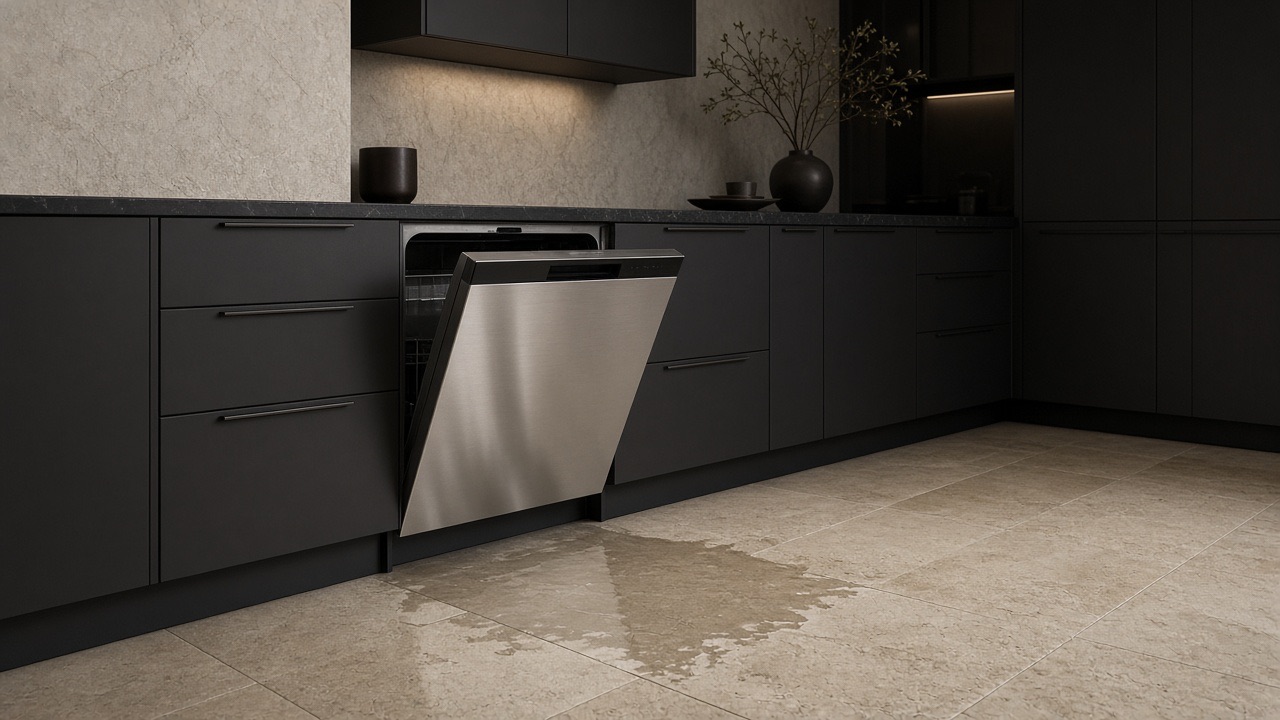
A Dacor dishwasher leaking onto limestone is an urgent stop-use item. Door corner drips, toe-kick puddles, and LC leakage codes are not the same leak. Foam from the wrong detergent can also look like a failed door gasket.
Water at the front corners during a wash is usually door seal or oversuds. Water only at the end of drain is often the hose. Water with an LC code on Modernist DDW24M/T families is a pan or float event. Do not ignore it because the dishes came out clean.
| Symptom | What it can point to | What you can check |
|---|---|---|
| Water at the door corners during the wash | A door seal that is folded or dirty, or too much suds | Look at the seal and confirm only dishwasher detergent was used |
| Water only after the drain stage | The drain hose or its connection | Check whether water appears only at the end of the cycle |
| Puddle under the front with LC on the display | The leakage sensor has tripped | Close the supply and switch off the dishwasher breaker |
| Water at the sides of the cabinet | A connection or fill line leak | Look under the sink without reaching behind live parts |
| Foam on the floor | Wrong detergent creating suds | Switch to dishwasher detergent and run a rinse |
A wet floor plus a live dishwasher is a skip-the-reset situation. Dry the floor so you can see if the leak returns on the next fill.
For a 24-inch Dacor dishwasher, the manual describes code LC as a leakage check. It says to close the water supply, switch off the dishwasher breaker, and contact the installer. Those are the actions the manual puts first, and they are the ones to take before anything else.
The manual also mentions wiping moisture from the leakage sensor as part of the install leak-fix steps. That is installer-level work and not a reason to open the base of the machine. A sensor that trips once has still done its job, so treat the code as a real leak until a technician says otherwise.
Check your own model’s manual before assuming LC means the same thing on an older Dacor.
None of those is confirmed by the symptom alone. Wiring, connectors, restrictions, and the control can produce the same kitchen experience as a failed part.
The manual says to use dishwasher detergent only, because other types foam excessively. Suds can push out around the door and look like a bad seal. The same manual says not to remove the front door seal, and to use a damp cloth for limescale or grease on it.
Installation requirements in the manual include water pressure between 20 and 120 psi and checking connections and the drain hose for leaks. Those points tell a technician where to look, and they are not owner repairs.
Keep the cause separate from the symptom. Water at the front can come from the seal, the suds, or a leak underneath that has run forward, so one look at the door does not settle it.
Drying the floor and running one fill is a way to learn where the water comes from. If it appears at the door during the wash, the seal and suds are the first suspects. If it appears only at drain, the hose side is more likely.
The test does not clear a leak that is under the machine and slow. A floor that stays dry for one fill does not mean the problem is gone, so watch the area again on the next use.
If LC appears at any point, stop testing and follow the manual’s steps: close the supply and switch off the breaker.
Book dishwasher repair the same day if water reaches the floor or if LC returns. Do not keep running “just one more load.”
No. Stop the cycle, close the supply and switch off the breaker if you can reach them safely. Running another load adds water to a floor you cannot see under.
Excess suds can push water out around the door, which looks like a seal leak. The manual says only dishwasher detergent should be used, since other types foam excessively.
On the 24-inch manual it is a leakage check. The manual says to close the supply, switch off the dishwasher breaker and contact the installer.
No. Dishes can come out clean while water escapes at a corner, a hose connection or under the tub. The article’s advice stands: watch the floor, not the dishes, and take an LC code seriously even after a good wash.
Wipe up so you can see what returns, but do not treat dry as fixed. If water appears again on the next fill, stop using the machine and book.
LC is a leakage check. You may see a pan event before a visible puddle.
Some gaskets pull into a channel. If the leak is under the tub, stop.
Yes. Built-in boxes wick water into the toe-kick quickly.
Yes. Drain what you can and leave the door cracked only if the floor is dry.
Share a few details and we’ll confirm an appointment. Prefer to talk? Call us and we’ll help right away.
Fields marked with * are required.